The universal thickness of mid-infrared bubbles
Abstract
Context. Several hundred ring-like structures seen at 8 μm in the Spitzer GLIMPSE surveys share a strikingly uniform morphology: the thickness ∆R of the emitting shell is a nearly constant fraction of its outer radius R, ∆R/R ~ 0.3, across a factor of 40 in size and across all exciting stellar spectral types. No explanation for this invariance has been given so far.
Aims. We investigated which physical quantity sets the observed shell thickness and whether the near-constancy of ∆R/R is a genuine physical fingerprint or a measurement artifact.
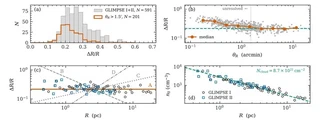
Methods. We derived purely analytic constraints on the location, temperature, and heating of the emitting grains and compared the resulting predictions for the scaling of ∆R/R with bubble radius against the combined GLIMPSE I and II bubble catalogs (591 objects, 91 with kinematic distances).
Results. Grains in radiative equilibrium at the observed radii only reach 20–35 K and fall short of the required 8 μm emissivity by more than 20 orders of magnitude; the emission must be carried by stochastically heated polycyclic aromatic hydrocarbons and very small grains, and it therefore originates in the photon-dominated region, where the ring width is the far-ultraviolet penetration depth. This gives ∆R/R = AVPDR/AVcloud, independent of radius. A swept-up shell instead predicts ∆R/R ∝ (R/RS)3/2, with RS the initial Strömgren radius. We found a pronounced angular-resolution systematic that inflates ∆R/R for the smallest bubbles; once this is accounted for, ∆R/R = 0.217. Its residual dependence on physical radius is 0.03 ± 0.05, consistent with zero; a fixed ambient density is excluded at 20σ and the swept-up shell at 9–28σ. The implied ambient columns are Ncloud ≈ 8.7 × 1021 cm-2, with a scatter of only 0.112 dex.
Conclusions. The near-universal appearance of mid-infrared bubbles follows from the ratio of two nearly invariant column densities: the dust-opacity-fixed far-ultraviolet shielding column, and the Larson-like column of the parent molecular cloud. It requires no reference to stellar wind properties.
Type
Letter
Publication
Astronomy & Astrophysics, 714, L12 (2026)
Status
Peer-reviewed
Open access
publications